

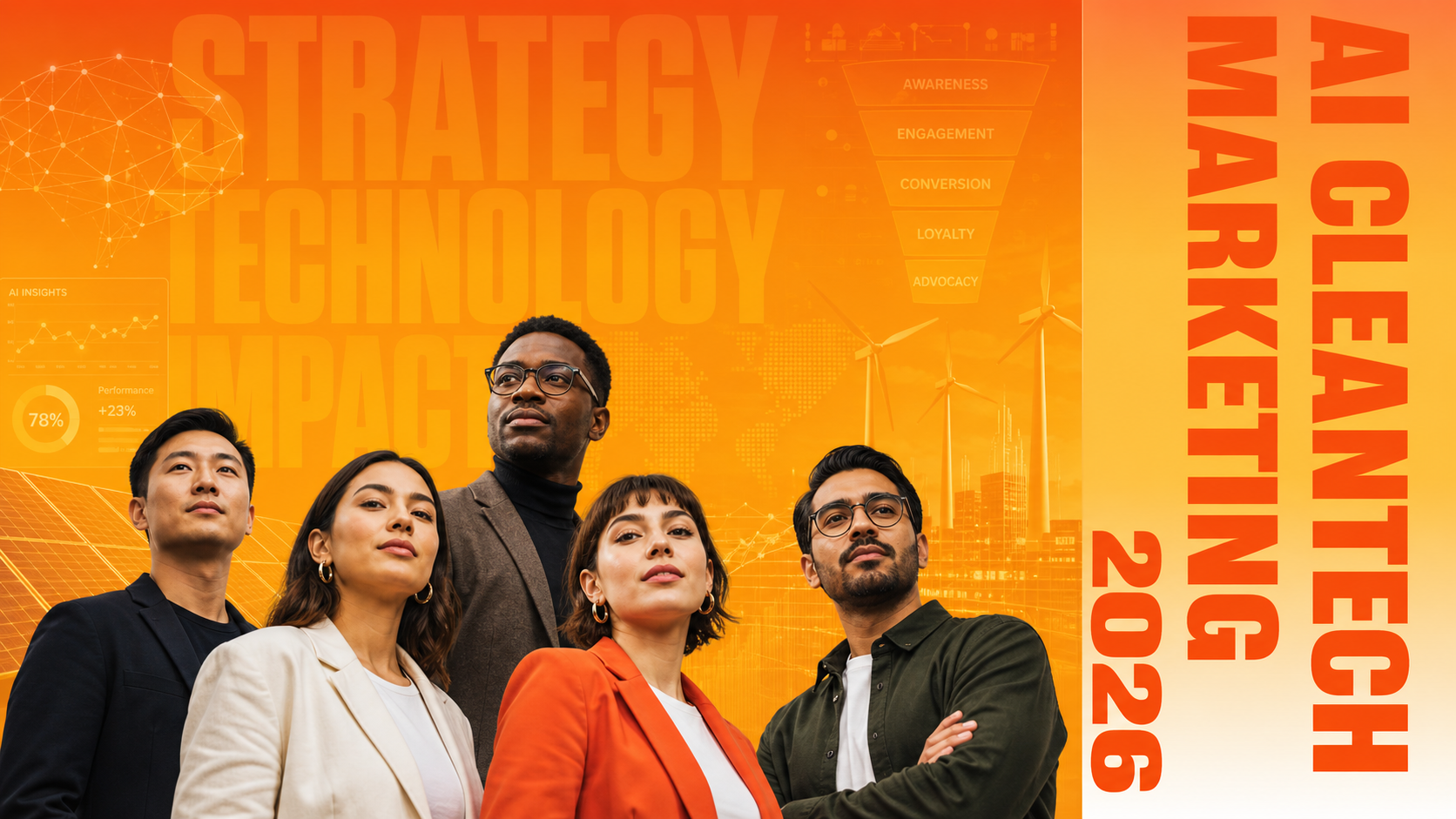
The cleantech sector sits at the intersection of urgency and innovation. As the global push toward decarbonization accelerates, even more so now with the recent disruptions in energy supply chains causing gas prices to surge and making the need for sustainable energy alternatives more relevant and urgent than ever, organizations are not only competing on technology, but on how effectively they communicate value, build trust, and drive adoption.
Artificial intelligence, AI, is fundamentally reshaping digital marketing. For cleantech organizations, it is unlocking new ways to engage high value audiences, scale content, and translate complex energy solutions into clear, compelling narratives.
At Helena & Arrow, we view AI not as a replacement for strategy, but as a multiplier of it. We have integrated AI across our operations, from content creation and SEO optimization to workflow automation and communication, enabling faster execution and stronger marketing performance.
Why AI Adoption Matters in Cleantech Marketing
Against this backdrop, AI adoption is no longer optional, it is becoming a strategic imperative.
Cleantech marketing is inherently complex. Buyers often include utilities, municipalities, regulators, and enterprise stakeholders each with different priorities, long decision cycles, and high expectations for credibility.
AI enables organizations to meet this complexity with clarity by:
- Targeting high-value audiences with greater precision
- Personalizing messaging based on user behavior and intent
- Accelerating content development for education-heavy sales cycles
- Continuously optimizing performance across channels
The result is more efficient demand generation and faster pathways to adoption.
Key Shifts Reshaping Cleantech Digital Marketing
To understand how to operationalize AI, it’s important to first recognize the structural shifts already underway.
1. AI Driven Demand Generation: From Awareness to Action
Demand generation is evolving from broad awareness to precision engagement.
Traditional marketing funnels are no longer sufficient. Cleantech organizations, especially those operating in complex ecosystems like DERMS, microgrids, and energy efficiency programs require more targeted, data-driven approaches.
AI enables:
- Predictive targeting of high-intent customers (utilities, municipalities, enterprise buyers)
- Behavioral segmentation based on real-time engagement data
- Personalized messaging across email, web, and paid media
What this means for cleantech:
You can move beyond generic sustainability messaging and speak directly to the operational, financial, and regulatory pain points of your audience thereby driving stronger engagement and higher conversion.
2. Hyper-Personalization at Scale
One size fits all messaging no longer works in cleantech.
AI allows organizations to:
- Tailor website experiences dynamically based on visitor profiles
- Build lifecycle-based email journeys
- Customize content by industry (e.g. C&I vs. residential vs. public sector)
The shift: From campaigns → to adaptive experiences
3. Smarter Content, Faster Execution
Building on this evolution, content becomes one of the most immediate and high-impact areas for AI adoption.
AI is redefining content production not by replacing human insight, but by accelerating it.
For cleantech organizations, this means:
- Rapid generation of thought leadership (whitepapers, blogs, policy explainers)
- SEO optimization aligned with emerging search trends in climate tech
- Repurposing long-form content into multi-channel assets (LinkedIn, newsletters, sales enablement)
But here’s the differentiator:
In a space as technical and mission-driven as cleantech, credibility is everything. AI can draft but human expertise must validate, refine, and lead.
4. Data Driven Storytelling: Turning Complexity into Clarity
Cleantech solutions often involve complex systems, including grid optimization, energy load balancing, and emissions modeling.
AI powered tools enable marketers to:
- Translate technical data into compelling narratives
- Visualize real time impact, including carbon savings and cost reductions
- Build dashboards for stakeholders and decision makers
The opportunity:
Make the invisible visible. Turn kilowatt-hours and algorithms into stories that decision-makers understand and act on.
5. AI + ABM: Precision Growth for High Value Markets
Account Based Marketing, ABM, is essential in cleantech, where deals are high value and stakeholder heavy.
AI enhances ABM by:
- Identifying high fit accounts
- Mapping stakeholder ecosystems
- Delivering tailored, multi touch campaigns
Result:
Shorter sales cycles, higher conversion rates, and stronger alignment between marketing and business development.
6. Ethical AI and Trust in a Mission-Driven Ecosystem
Trust is central to cleantech.
As AI adoption deepens, maintaining trust and intellectual integrity is becoming increasingly critical.
Cleantech organizations carry a unique responsibility, and trust is part of the product.
- Transparency in messaging becomes essential
- Data privacy and responsible use must be prioritized
- Authenticity must remain at the core of every campaign
AI should enhance your voice not dilute your mission.
A Practical Framework for AI Adoption in Cleantech Marketing
While the opportunities are clear, successful implementation requires a structured approach.
1. Audit your current marketing ecosystem
Evaluate your existing tools, workflows, and data sources to identify gaps and opportunities.
2. Prioritize high-impact use cases
Start where AI can drive immediate value, such as content creation, email automation, SEO, and lead scoring.
3. Build integrated workflows
Ensure your AI tools are connected across your marketing stack to avoid fragmentation and inefficiency.
4. Align with sales and product teams
In cleantech, alignment is critical. Marketing must reflect technical capabilities and support complex stakeholder journeys.
5. Establish governance and quality control
Maintain accuracy, compliance, and brand consistency especially important in regulated environments.
High-Impact Use Cases for Cleantech Organizations
With the right foundation in place, AI can be applied across several high-value marketing functions:
- Direct response programs: Improve segmentation and targeting for incentive-based campaigns
- B2B demand generation: Support account-based marketing with predictive insights
- Thought leadership: Accelerate development of blogs, whitepapers, and policy content
- Sales enablement: Create tailored proposals and stakeholder communications
- Performance marketing: Optimize paid campaigns in real time
These applications not only improve efficiency, but they also directly support revenue growth and program adoption.
The Role of Advanced AI Models
Recent advancements in models like Claude AI, particularly Claude 3 and beyond are rapidly reshaping what’s possible in digital marketing. From handling long-context analysis (e.g., parsing dense policy documents or energy program requirements) to generating highly structured, nuanced content, these tools are becoming increasingly capable of supporting complex, technical industries like cleantech.
For example, AI can now:
- Analyze utility program documents and extract key insights for messaging
- Generate tailored proposals and stakeholder communications at scale
- Support faster iteration of product positioning and go-to-market strategies
But here’s the reality: AI alone is not a strategy. It still requires a human hand to:
- Interpret nuance in policy, regulation, and stakeholder dynamics
- Align messaging with business goals and market realities
- Guide organizations through adoption, integration, and change management
And that’s where many organizations get stuck.
Ultimately, AI is not the strategy, it is the enabler.
For cleantech organizations, where trust, accuracy, and impact matter deeply, this balance is essential.
Common Pitfalls to Avoid
As organizations move from experimentation to adoption, several common challenges emerge.
These include:
- Treating AI as a standalone solution rather than part of a broader strategy
- Operating tools in silos without integration
- Lacking the data infrastructure needed to support AI effectively
- Inconsistent messaging or loss of brand voice
- Overlooking compliance and regulatory considerations
Addressing these risks early ensures a more sustainable and scalable implementation.
The Helena & Arrow Perspective
The future of digital marketing in cleantech isn’t just about adopting AI, it’s about integrating it strategically. At Helena & Arrow, we believe the winning formula is:
Strategy + Technology + Execution = Scalable Impact
AI accelerates execution.
But strategy defines direction.
And execution delivers results.
At Helena & Arrow, we aim to help cleantech organizations not only adopt AI but to also fully operationalize it, transforming tools into systems and strategy into measurable return on investment.
If you are looking to:
- Implement AI in digital marketing
- Improve demand generation and SEO performance
- Scale your cleantech marketing strategy, and more
Let’s talk.
👉 Book a free consultation:
https://book.titan.email/helenaandarrow
📩 info@helenaandarrow.com

Leave a Reply